AI's Double-Edged Sword: How Artificial Intelligence Is Tackling Its Own Energy Appetite in Data Centers
1/2/20261 min read
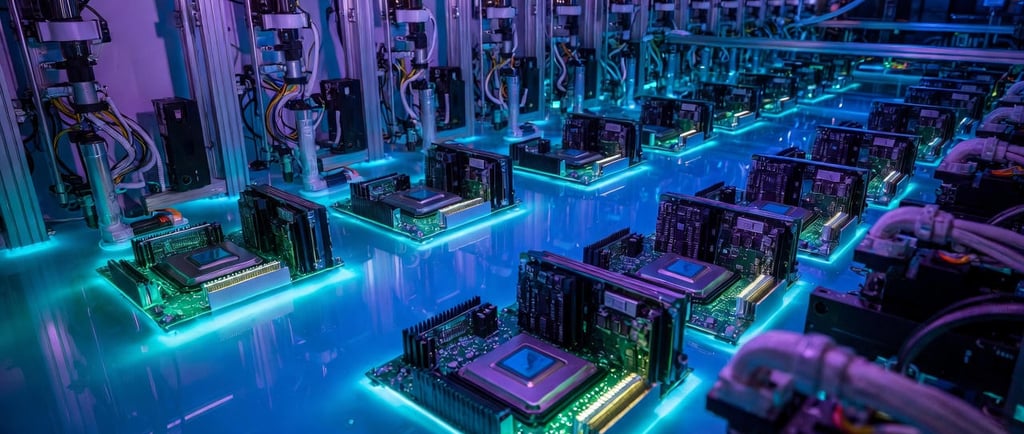
The surge in artificial intelligence applications has dramatically escalated data center electricity consumption, with global usage estimated at approximately 415 TWh in 2024, accounting for about 1.5% of worldwide electricity demand [1]. AI-optimized servers and high-density GPUs are the dominant drivers, as cooling infrastructure typically consumes 38-40% of total power in these facilities [2]. Traditional air-based systems are increasingly inadequate for rack densities exceeding 100kW, necessitating advanced thermal management strategies.
AI technologies are proving instrumental in partial mitigation. Reinforcement learning algorithms, such as those developed by Google and DeepMind, dynamically optimize cooling by analyzing thousands of sensor inputs every few minutes to adjust fan speeds, chillers, and setpoints. This approach has consistently achieved up to 40% reductions in cooling energy usage, contributing to overall Power Usage Effectiveness (PUE) improvements [3]. When integrated with digital twins and predictive models, these systems enable proactive adjustments that align cooling precisely with real-time IT loads.
Complementing AI optimization, the industry is accelerating adoption of liquid cooling solutions. Direct-to-chip and immersion cooling methods transfer heat more efficiently than air, reducing cooling energy demands by 50-90% and supporting extreme densities required for AI workloads [4]. In 2025-2026, liquid and hybrid systems are becoming standard in new hyperscale builds, with immersion cooling gaining traction for its superior efficiency and minimal water usage.
These combined advancements—AI-driven controls and advanced cooling architectures—demonstrate how the technology fueling energy growth is also enabling significant efficiency gains, particularly in the cooling domain.
Looking ahead, while absolute electricity consumption is projected to rise substantially—with estimates ranging from 650-1,050 TWh globally by 2026 and approaching 945 TWh by 2030 due to unrelenting AI expansion—these innovations could offset 20-50% of cooling-related demands, moderating growth trajectories and facilitating integration with renewables for more sustainable scaling [5].
[1] International Energy Agency - Energy and AI Report [2] Deloitte - Generative AI Power Consumption Insights [3] Google DeepMind - AI for Data Center Cooling [4] Schneider Electric - Liquid Cooling for AI Data Centers [5] International Energy Agency - Electricity Mid-Year Update 2025
Contact details:
Email: george@georgeralston.com
Phone:
+39 331 802 9277 (Italy) or
+1 281 932 6226 (USA)